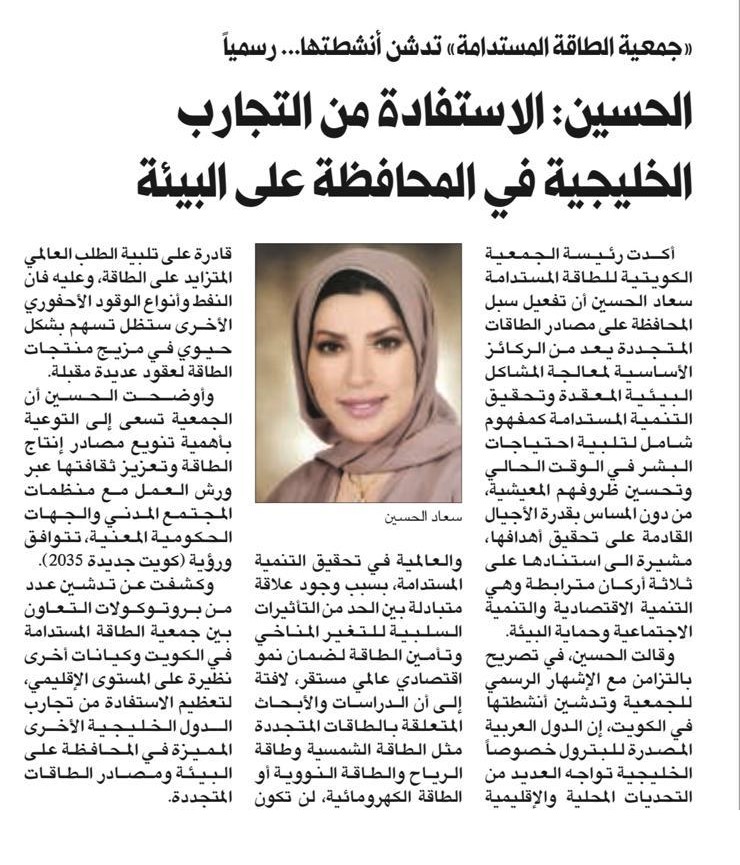
The president of the Kuwaiti Society for Sustainable Energy, Suad Al-Hussein, affirmed that activating means of preserving renewable energy sources is a fundamental pillar in addressing complex environmental issues and achieving sustainable development as a comprehensive concept to meet human needs at the present time. It aims to improve their living conditions without compromising the ability of future generations to achieve their goals. She pointed to three interconnected pillars: economic development, social development, and environmental protection.
Al-Hussein, in a statement coinciding with the official announcement of the society and the launch of its activities in Kuwait, mentioned that Arab oil-exporting countries, especially those in the Gulf region, face numerous local, regional, and global challenges in achieving sustainable development. This is due to the mutual relationship between mitigating the negative impacts of climate change and securing energy to ensure stable global economic growth. She noted that studies and research related to renewable energies, such as solar energy, wind energy, nuclear energy, or hydropower, will not be able to meet the growing global demand for energy. Consequently, oil and other fossil fuel types will continue to play a vital role in the energy product mix for many decades to come.
Al-Hussein explained that the society aims to raise awareness of the importance of diversifying energy production sources and promoting its culture through workshops with civil society organizations and relevant government entities, aligning with the vision of “New Kuwait (2035).” She revealed the launch of several cooperation protocols between the Kuwaiti Society for Sustainable Energy and other similar entities at the regional level. This initiative aims to maximize the benefit from the distinctive experiences of other Gulf countries in preserving the environment and energy sources.